When AI redacts your PDF, where does the file go?
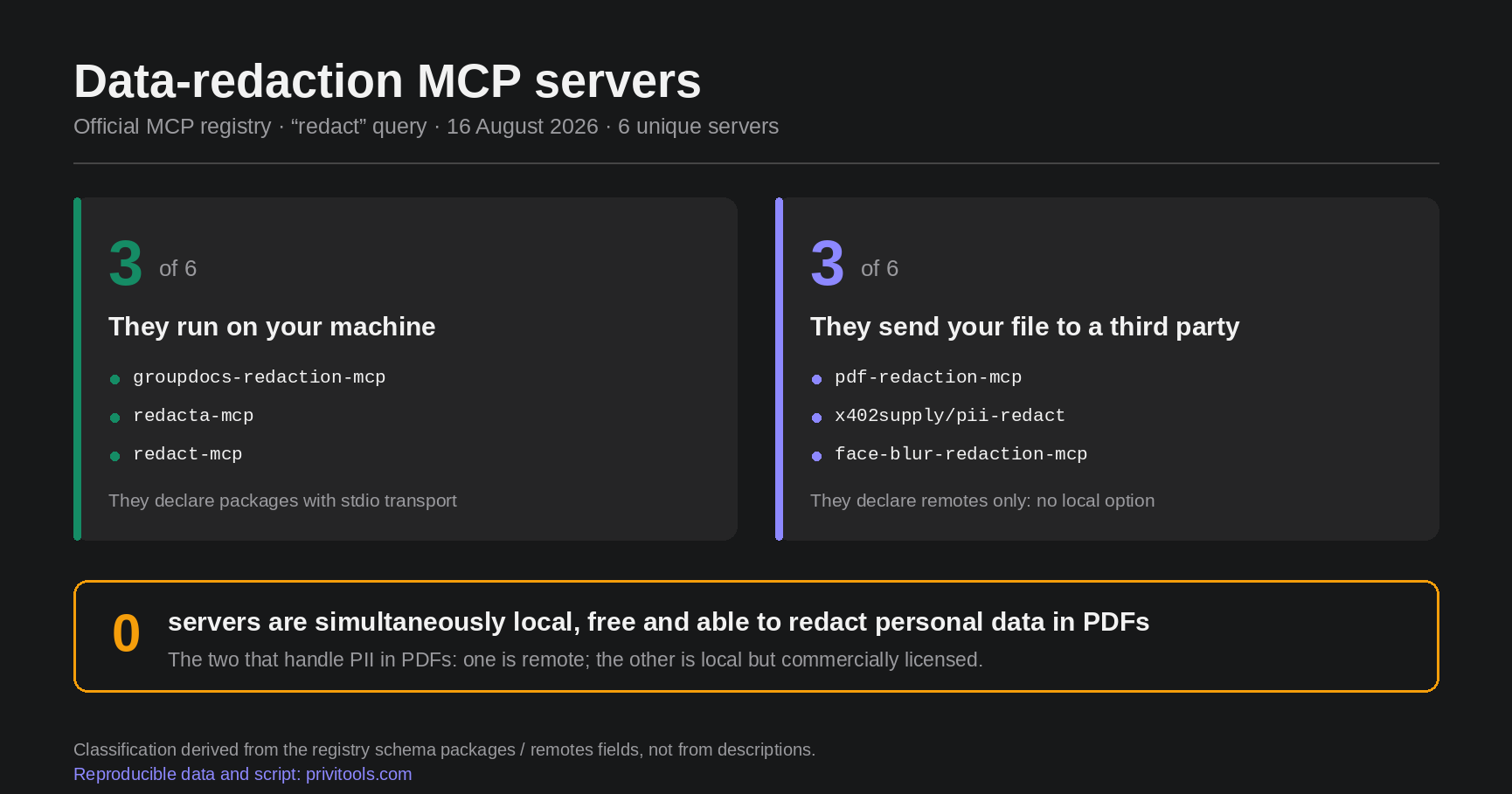
You ask your assistant to strip the personal data out of a document before you share it. The assistant has a tool for that. The tool works. Nobody tells you whether the document left your computer.
MCP makes that question answerable without guesswork, because every server
publishes its transport to a public registry. A server that declares
remotes receives your data on someone else’s machine, necessarily. One that
declares packages with stdio transport runs on yours. You don’t have to take
anyone’s word for it: it’s in the metadata.
So we counted.
Method
We queried the official MCP registry on 16 August 2026:
GET https://registry.modelcontextprotocol.io/v0/servers?search=redactThe response returned 13 entries and no nextCursor — the set was
exhausted. Keeping only the latest version of each server leaves 6 unique
servers.
Each was classified by schema fields, never by the text of its description:
packageswith no environment variable markedisRequired+isSecret→ localpackageswith a mandatory API key → bridge to a remote APIremotesonly → remote
The script is published in the repository, and anyone can repeat the run:
node scripts/backlinks/mcp-registry-audit.mjs redact --jsonResults
| Server | Architecture | Scope | Cost |
|---|---|---|---|
com.pdf-redaction/pdf-redaction-mcp |
Remote | PDF + PII | Remote API |
com.x402supply/pii-redact |
Remote | Text only | $0.02 per call |
com.dyndns-server.noon-ai/face-blur-redaction-mcp |
Remote | Image and video | — |
io.github.groupdocs-redaction/groupdocs-redaction-mcp |
Local | Documents | Commercial licence |
io.github.nickjlamb/redacta-mcp |
Local | Text only | Free |
io.github.r3352/redact-mcp |
Local | Text only | Free |
Three of six run on your machine. The other three receive the content on a third-party server — not as a configuration option, but as the only architecture on offer.
The empty box
Of the six, two can handle personal data inside a PDF. One is remote. The other is local but requires a commercial licence; without it, it runs in evaluation mode.
Which means: there is currently no MCP server that is simultaneously local, free, and able to detect and redact personal data in PDF files. The two that are local and free work on plain text only. Anyone who needs to redact a PDF without it leaving their machine and without buying a licence has no option in the registry.
A second, narrower gap: none of the six recognises Latin American tax identifiers — RFC, CURP, RUC, CUIT, NIT, RUT — which are precisely the personal data that appear on invoices and case files across half a dozen countries.
The limits of this method, which are real
This measures declared architecture, not audited behaviour. It’s worth being explicit about what the count does not prove:
- A local package could open sockets anyway. The registry says how software is distributed, not what it does inside.
- A remote server is not automatically bad. For many tasks it’s the sensible choice, and some operators handle data more rigorously than an unencrypted laptop does.
- Descriptions were not audited. We found at least one case where the description speaks of on-device processing while the entry declares remote transport only; most likely the sentence describes the project’s web application rather than its MCP server.
What the count does prove is narrower and more useful: if a server declares
only remotes, your file leaves your machine. That admits no nuance.
How to check it yourself, in two minutes
Declared architecture is verified by running the server with no network. If it still works, it wasn’t calling anywhere:
# Linux
unshare -rn node dist/index.js

# macOS or Windows, with Docker
docker run --rm --network none -v "$PWD":/app -w /app node:20 node dist/index.js
A server that needs the internet fails here immediately. It’s the cheapest test there is, and it works for any MCP server, not just redaction ones.
Data
The full dataset, with each server’s classification and a link to the original
query, is in the repository as
data/backlinks/mcp-redaccion-registro-2026-08-16.json. Reuse it and check it.
One caveat about the date: the registry changes weekly. These figures are from August 2026 and will not hold in two months. The script still will.
PriviTools publishes @privitools/mcp, one of the local servers in this
category. It works on text, not PDFs: we don’t fill the empty box described
above either. That seemed more honest than writing a survey we happened to win.
 How to audit a browser-based file tool without trusting its privacy claim
 How to redact a PDF permanently: a black rectangle is not enough